


Do More Suppliers Mean More Specialist Expertise?
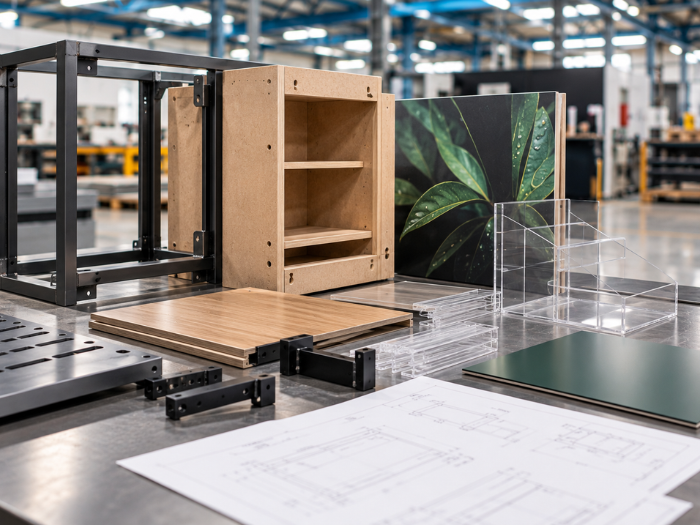
Retail displays can bring together a surprising number of different disciplines. A single unit might include fabricated steelwork, joinery, plastic components, printed graphics and specialist finishes. Then it needs to be assembled, packed, transported and potentially installed across multiple stores.
In theory, you could appoint a different specialist for every part. And sometimes that will be exactly the right approach. But adding more suppliers doesn’t automatically add more expertise to the finished project. It also adds more handovers.
Specialists are valuable
There are plenty of situations where a project needs a particular skill, process or technology that is best provided by a specialist supplier. The important distinction is between having access to specialist expertise and automatically assuming that every discipline needs to sit within a separate business.
For a multi-material retail display, the individual components ultimately have to become one finished product. That means the way those specialists work together matters too.
Every handover creates another conversation
Imagine a relatively straightforward display with a fabricated metal frame, timber cabinetry, plastic product holders and printed graphics. If each element is being manufactured separately, somebody needs to make sure they all come together correctly.
- Who establishes the tolerances between the metalwork and joinery?
- Who checks that a design change made to one component doesn’t cause a problem somewhere else?
- Who decides which part needs adjusting if two components don’t quite fit?
- Who has the latest drawing?
- When does one supplier need to finish so the next can begin?
None of these questions is necessarily difficult to answer. But every interface introduces another point that needs to be managed. Multiply that across several suppliers and a project can accumulate a surprising number of conversations, drawings, deliveries and dependencies.
One small change can travel a long way
This becomes particularly noticeable when something changes. Retail projects evolve. A prototype might reveal an improvement. Product dimensions could change. A retailer might request an alteration. A component may need to be strengthened or a finish adjusted.
Consider a change to the dimensions of a timber cabinet. That change might also affect the metal frame surrounding it, a plastic component attached to it and the graphic panel sitting across the front.
With several suppliers involved, the revised information needs to reach everybody affected, and each supplier needs to understand what it means for their part of the project.
At Benchmark, those conversations can happen between teams working within the same manufacturing operation. The joinery team can talk to metalwork. Metalwork can talk to design. Plastics can be brought into the conversation. The project team can see how the change affects assembly and installation. The expertise is still specialist. It is simply closer together.
The finished display doesn’t care who made each component
Ultimately, a customer standing in a store sees one display. They don’t see the organisational chart behind it. They won’t know that one supplier manufactured the frame, another produced the cabinetry and somebody else made the plastic components.
- They will notice if the gaps don’t line up.
- They will notice if colours or finishes are inconsistent.
- They will notice if something doesn’t fit properly.
For the finished display to work, all of its individual elements need to work together. That makes coordination an important part of manufacturing quality.
Prototyping becomes a shared exercise
This links closely to another subject we’ve covered in our Myth Busting series: prototyping. A prototype can uncover issues at the points where different materials and components meet. Perhaps a fixing is difficult to reach once the timber component is fitted to the metalwork. Maybe a plastic insert needs slightly more clearance. Perhaps changing one component would make the whole unit considerably quicker to assemble.
When the people responsible for those different disciplines can examine the same prototype and discuss it together, the learning can be shared immediately. Rather than each team concentrating solely on its own component, everyone can consider the finished display.
There are practical benefits on the factory floor too
Bringing multiple manufacturing disciplines together can also simplify the physical movement of a project. Components don’t necessarily need to travel between several different suppliers before final assembly. Teams can coordinate production schedules around one another. Parts can be trial fitted during manufacture. Finishes and materials can be viewed together.
And once everything is ready, the complete display can be assembled and checked before it leaves the factory. For complex projects or high-volume rollouts, reducing some of those external dependencies can make the overall programme easier to control.
Sometimes several suppliers will still be the right answer
There will always be projects that require processes, materials or expertise from outside a manufacturer’s own capabilities. Benchmark works with external suppliers where a project requires it. The goal isn’t simply to maximise or minimise the number of companies involved.
What does matter is assembling the right expertise for the job and making sure those different disciplines work effectively together. For many of the retail displays we manufacture, being able to produce wood, metal, plastics and print within the same operation means a significant proportion of that expertise is already here.
Specialist expertise works best when it connects
Walk around our 120,000 sq. ft. manufacturing facility in Letchworth and you will see very different disciplines at work.
- The equipment in metalwork looks very different from the machinery in joinery.
- Plastics requires another set of skills again.
- Print and finishing bring their own expertise.
But the projects moving through those areas are often the same projects. That is where bringing those capabilities together becomes particularly useful. A multi-material retail display still needs specialists. The fewer barriers there are between them, the easier it becomes to make their expertise work as one.
Planning a multi-material retail display project?
Benchmark brings design, joinery, metalwork, plastics, print, finishing, assembly and installation together through one UK manufacturing operation.
Call 01462 633000 or email sales@bench-mark.co.uk to talk to the Benchmark team.