

Myth Busting: Does Retail Display Manufacturing Only Work at High Volumes?
When people picture manufacturing at scale, they tend to picture long production runs.
Hundreds, perhaps thousands, of identical units moving through a factory.
Retail display manufacturing can certainly look like that.
A national campaign might require the same display to be manufactured for hundreds of stores, produced to a consistent specification and delivered within a relatively tight window.
But that’s only one type of project that comes through our factory.
Sometimes we make hundreds.
Sometimes we make ten.
Sometimes we make one.
The national rollout
High-volume production is an important part of what we do at Benchmark.
A retailer or brand may have developed a new display concept that needs to appear across a large proportion of its estate at roughly the same time.
Once the design and prototype have been approved, the challenge becomes one of repeatable manufacture.
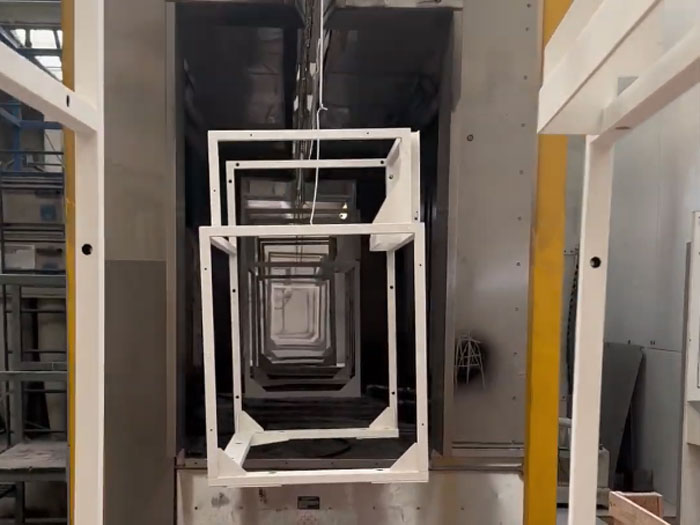
Components need to be produced efficiently. Finishes need to remain consistent. Different materials and manufacturing processes need to come together at the right time. Assembly, packing, storage and distribution all have to keep pace.
Producing 500 units isn’t simply the process of making one unit 500 times.
It requires planning specifically for volume.
Then the rollout finishes. The requirement doesn’t.
This is something that can easily be overlooked at the beginning of a retail display programme.
Imagine an initial order has successfully been manufactured and rolled out across a national retail estate.
A few months later, another store opens.
Then a display somewhere else is accidentally damaged and needs replacing.
Another location is refurbished.
Perhaps the retailer decides to introduce the concept to a handful of stores that weren’t included in the original rollout.
The original requirement for hundreds of units can quickly become a requirement for five, ten or perhaps just one.
We’ve seen exactly this pattern with projects at Benchmark.
Being able to support those smaller follow-on orders can be just as important as having the capacity to manufacture the original rollout.
The drawings already exist. The construction is understood. Specifications and finishes can be referenced. Our teams know how the product was made.
That makes it possible to revisit an established project and manufacture further units when they are actually needed.
Not every project starts with volume
There is another side to this entirely.
Some retail displays are never intended to be produced in large numbers.
A brand launching an important new product might want a substantial bespoke display for a flagship location.
A department store concession might need a small number of highly customised fixtures.
A new concept might initially be trialled in just one or two stores.
These projects can still involve considerable design, engineering and manufacturing work. They may combine fabricated metalwork, joinery, plastics, lighting, graphics and specialist finishes.
The complexity can be significant even when the quantity is one.
In these situations, manufacturing capability is less about how many identical units a factory can produce and more about whether it has the skills and equipment to create the thing in the first place.
Scale means different things on different projects
This variety is one of the interesting things about retail display manufacturing.
One area of our Letchworth facility might be producing components for a national rollout while somewhere else a team is assembling a single bespoke fixture.
Both require manufacturing expertise.
They simply require it in different ways.
Our 120,000 sq. ft. facility brings joinery, metalwork, plastics, print, finishing and assembly together under one roof, which gives us the ability to accommodate very different types of work.
It also means a project doesn’t necessarily have to fit neatly into a particular volume bracket.
From the first unit to the next one
For brands and retailers, it is worth thinking about volume beyond the initial purchase order.
What happens after the rollout?
Could new stores require additional units?
Will replacements eventually be needed?
Might the design be reused elsewhere?
Could the first flagship installation become the basis for something larger?
The answer isn’t always known at the beginning.
Having a manufacturing partner that can accommodate those changes gives the project somewhere to go next.
So while high-volume production is an important part of what happens at Benchmark, some of the most interesting jobs that pass through our factory are produced in surprisingly small numbers.
One unit, ten units or a national rollout?
If you’re planning a retail display project, we’d be happy to talk through what you need now – and what you might need later.
Call 01462 633000 or email hello@bench-mark.co.uk to talk to the Benchmark team.