

Is a Prototype Just a Sample?
When you already have drawings, renders and detailed specifications for a retail display, producing a prototype can sometimes feel like an additional expense. After all, if you are ultimately going to manufacture 300 units, what is the value in making just one first? Quite a lot, potentially.
A prototype gives you something that drawings and renders cannot fully provide: the opportunity to experience the display in the real world before committing to volume production. And, importantly, the opportunity to learn from it.
Finding problems while they are still easy to solve
Imagine discovering an issue with the first prototype. Perhaps a product doesn’t sit quite as expected. A shelf needs additional support. A component is awkward to assemble. A door doesn’t open as conveniently as anticipated.
At prototype stage, you have found one problem on one unit. Now imagine discovering exactly the same issue after 300 displays have been manufactured.
“The problem hasn’t changed. The consequences have.”
This is one of the most valuable roles a prototype can play. It creates an opportunity to identify potential issues while there is still time to change drawings, materials, components or manufacturing methods before those decisions are repeated across an entire production run.
Does the product actually fit?
This sounds like something that should be answered by a drawing. Often it can be. But putting the real product into the real display can still reveal useful information.
- Does it sit naturally?
- Is it presented at the right angle?
- Can customers pick it up easily?
- Is there enough clearance?
- How many products can realistically be displayed?
- Can store staff replenish it efficiently?
There can be a difference between something fitting according to its dimensions and something working well when people actually start using it. A prototype gives you an opportunity to find that difference.
How does it feel?
Retail displays are physical objects. Customers lean on them, pick products up from them, open doors and drawers and interact with moving components. Store teams stock, clean and sometimes move them. A prototype lets you experience some of those interactions.
- Does the display feel stable?
- Do moving components operate as intended?
- Are shelves sufficiently rigid when loaded?
- Do materials and finishes look right together at full scale?
- Does the finished unit have the presence envisaged in the original concept?
Some of these questions can be explored during the design process. Others become much easier to answer when there is a physical unit standing in front of you.
The factory learns from it too
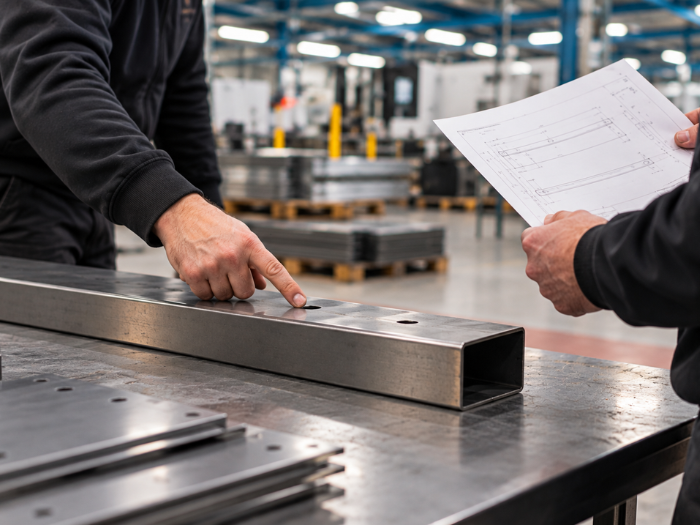
Prototyping isn’t only about evaluating the finished display. Building the first unit can teach the manufacturing team a great deal about how subsequent units should be made.
- A component might be more complicated to fabricate than expected.
- An assembly sequence could be improved.
- A fixing might be difficult to access.
- Two components might be combined into one.
- A manufacturing process might be changed to improve consistency or reduce production time.
At Benchmark, our design and manufacturing teams work closely together, so what is learned while producing a prototype can feed directly back into the technical development of the display. That can be particularly valuable when the next stage is volume production.
What happens when we need to make 300?
There is an important difference between proving that something can be made and establishing how it should be manufactured repeatedly. A one-off component can sometimes be produced using a method that would make little sense across hundreds of units. The prototype provides an opportunity to look at the wider manufacturing process.
- How will components be produced consistently?
- Can assembly be simplified?
- Could material usage be improved?
- Are tolerances appropriate?
- Are there opportunities to reduce production time without compromising the finished display?
These questions become increasingly important as volumes rise. A small improvement to one unit may be just that. Repeat it 300 times and it can become significant.
You can learn about installation too
Depending on the project, prototyping can extend beyond the display itself. A unit can be pre-assembled at our Letchworth facility to understand how it comes together. That can help determine which elements should travel assembled, which should be packed separately and how straightforward final assembly will be on site.
For some projects, an in-store trial can take the learning even further.
- Does the display work in the intended space?
- How straightforward is access?
- How long does installation actually take?
- Is there anything the installation team would change before a wider rollout?
Again, these are useful things to discover once. They are rather less useful to discover repeatedly across a national installation programme.
A prototype should answer questions
There is little value in producing a prototype simply to have an early version of the finished display. Its real value comes from what you learn from it.
- Test it.
- Load it.
- Use it.
- Look at it from the customer’s perspective.
- Ask store teams what they think.
- Let the manufacturing and installation teams examine it.
Find the awkward bits. Question the decisions that looked perfectly sensible on a drawing. Make changes where they improve the finished result. Then, when everyone is satisfied, you have considerably more than a sample. You have a display that has already been through its first round of real-world learning before volume production begins. And when the next step is making 300 of them, that can be extremely valuable.
Planning a retail display project?
Benchmark can support projects from initial concept and technical development through prototyping, manufacture and nationwide installation.
Call 01462 633000 or email sales@bench-mark.co.uk to talk to the Benchmark team.