
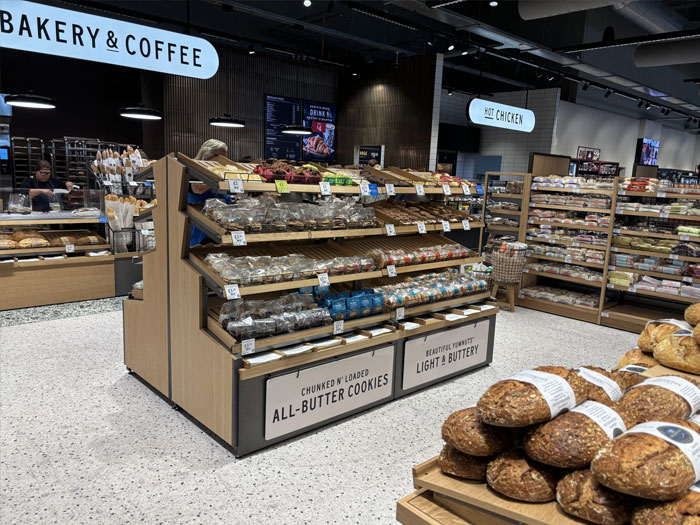


Are Retail Displays Just Boxes and Shelves?
Sometimes, the best retail displays look remarkably simple.
A few shelves. A frame. Some graphics. Perhaps a drawer or a cupboard underneath.
Put the finished unit in a store, fill it with products and there might not appear to be an enormous amount to it.
But take that same display back to the beginning of the process and things can look rather different.
Even a relatively simple retail fixture can involve dozens of decisions before it reaches the shop floor.
First, what actually needs to go on it?
It sounds obvious, but the product is a good place to start.
- What are its dimensions?
- How much does it weigh?
- How many products need to be displayed?
- How will customers pick them up?
- How will store staff replenish them?
- Could the product range change during the life of the display?
A shelf designed to hold a row of lightweight boxed products has a very different job from one supporting something considerably heavier.
Then there is the amount of stock the retailer wants to hold on the shop floor, how products need to be presented and how easy they need to be for customers to interact with.
All of that can influence the design.
Then there is the store itself
A display rarely exists in isolation.
- It has to work within a real retail environment.
- There may be a particular footprint available.
- Sightlines need to be considered.
- The display might sit against a wall, within an existing bay or completely freestanding.
- There may be restrictions on height or depth.
- Customers need to be able to move around it.
- Staff need to clean, replenish and maintain it.
And if the same concept is destined for multiple stores, there may be different store formats to accommodate.
A display can look beautifully simple from the front while solving quite a complicated spatial problem behind the scenes.
What should it be made from?
This is where the options multiply again.
Wood, metal and plastics can all bring different properties to a display, and many of the fixtures we manufacture combine several materials within a single unit.
- A metal structure might provide strength.
- Joinery might create the main body and surfaces.
- Fabricated plastic could provide product holders or more intricate details.
- Printed graphics and signage bring in the brand.
Then come the finishes. Paint, powder coating, laminates and other decorative finishes can all affect appearance, durability and how different components work together.
Getting a multi-material display to look like one cohesive product requires those decisions to be considered together.
How will we actually make it?
A concept also has to become a repeatable manufacturing process.
That can involve CAD drawings, prototypes, technical development and value engineering before production begins.
Our designers work closely with the manufacturing teams at Benchmark, so questions about how something will actually be made can be addressed while the design is being developed.
- Can a component be simplified?
- Is there a better way to fabricate it?
- Could changing a fixing make assembly easier?
- Can we reduce the number of separate parts?
- Will the design still work when we’re making 300 rather than three?
Sometimes the cleverest design decision is one nobody will ever notice in the finished display.
And how does it get to the store?
Eventually, the display has to leave the factory. That introduces another set of considerations.
- Can it travel fully assembled?
- Would that take up too much vehicle space?
- Should it break down into sections?
- How will those sections be protected?
- Can they be assembled quickly on site?
- Will the largest component fit through the available doors and access routes?
If hundreds of units are being distributed nationally, small improvements to packing or assembly can become significant across the whole programme.
So logistics and installation can influence decisions made much earlier in the design process.
The customer shouldn’t need to know any of this
Eventually, all of those decisions disappear into the finished product.
- A customer walks into the store.
- They see the brand.
- They see the product.
They pick something up, put it back or take an item from a shelf. Everything feels solid. Nothing gets in their way. Nothing particularly draws their attention to how the display itself has been constructed. That’s usually a good outcome.
The engineering, manufacturing and practical problem-solving are there to help the display do its job, rather than compete for attention.
Simple can take quite a lot of work
Retail displays can certainly be boxes and shelves. We’ve manufactured plenty of both.
But behind those boxes and shelves can sit decisions about materials, loading, tolerances, manufacturing processes, finishes, durability, packing, transportation, installation, customer behaviour and the practical realities of a busy retail environment.
At Benchmark, those considerations bring together people from design, joinery, metalwork, plastics, print, finishing, assembly, logistics and installation.
The finished display might look simple. Getting there can be anything but.
Got an idea for a retail display?
Whether you have detailed production drawings, an early-stage concept or simply a problem you’re trying to solve, we’d be happy to take a look.
Call 01462 633000 or email hello@bench-mark.co.uk to talk to the Benchmark team.